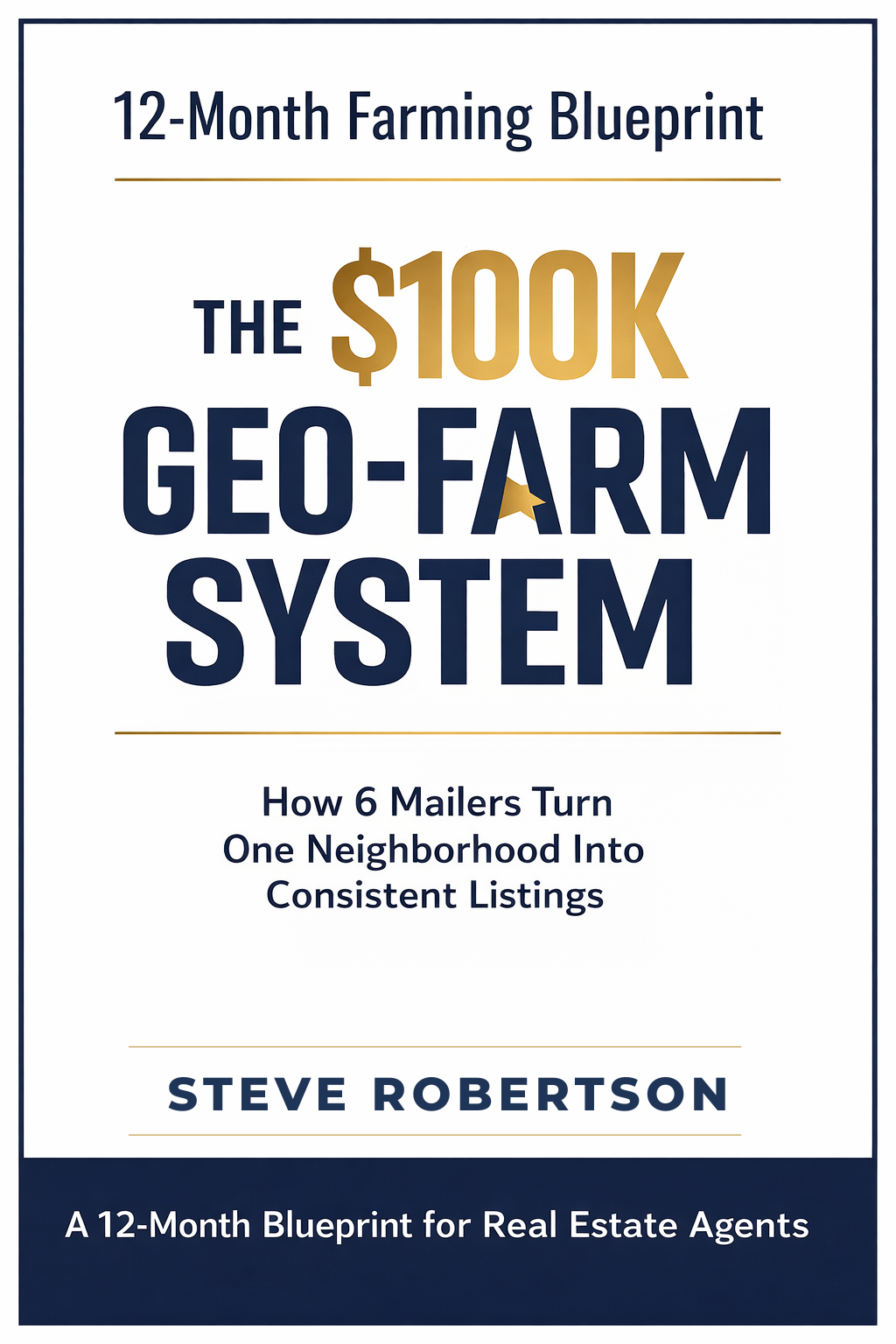
Geo-Farming in Real Estate: The 12-Month Blueprint That Turns $3,500 Into $100K
By Steve Robertson | Steve Sells Austin
Geo-farming, also called geographic farming or real estate farming, is a prospecting strategy where an agent markets consistently to one specific neighborhood until homeowners see them as the local expert. Done right, it is the highest-ROI listing strategy in real estate: a farm of 350 to 750 homes, six strategic mailers a year, roughly $3,500 in total cost, and a realistic path to $100,000 or more in gross commission income within the first year.
That is the entire premise of the 12-Month Farming Blueprint: The $100K GeoFarm System. This post breaks down how geo-farming actually works, why most agents fail at it, the exact mailer calendar the system runs on, and the numbers behind the ROI.
What Is Geo-Farming in Real Estate?
Geo-farming means picking one geographic area, your "farm," and becoming impossible to ignore inside it. Instead of chasing leads across an entire city, you concentrate your entire marketing budget and presence on a few hundred households, showing up in their mailbox, their search results, and their neighborhood conversations month after month.
The strategy works because of simple repetition psychology. Industry research consistently shows that prospects need five to seven meaningful touchpoints before they act. A homeowner who has seen your name on six pieces of well-timed, hyper-local mail does not need to search for an agent when it is time to sell. They already know one.
Why Most Agents Fail at Geographic Farming
If you have been an agent for more than a year, you have probably tried farming once: a few postcards, a couple of months of consistency, then silence when the listings did not come fast enough. Sound familiar?
Here is the hard truth. Farming did not fail you. The approach did. The four mistakes that kill nearly every farming campaign:
Inconsistent mailing. One postcard in January, another in April, then nothing. The compounding effect never starts.
Farms that are too large. Mailing 3,000 homes on a 750-home budget means nobody sees you often enough to remember you.
Generic messaging. A postcard that could come from any agent in any city gives homeowners zero reason to remember you specifically.
Quitting at touchpoint two or three. Most agents abandon the campaign right before the five-to-seven touchpoint threshold where momentum kicks in.
Every one of these is a systems problem, not a talent problem. Which is exactly why the blueprint is built as a calendar, not a collection of tips.
The 12-Month Geo-Farming Calendar: Six Mailers, Six Jobs
The entire system runs on six strategic mailers per year. Each one is timed to how homeowners actually make selling decisions and each format has a distinct psychological job.
Early Spring (February/March)
Mailer: Spring Market Kickoff
Format: Jumbo infographic postcard
Job it does: Lands as buyer demand climbs; plants the idea that “the market is moving.”
Late Spring (May)
Mailer: Neighborhood Market Data
Format: Jumbo postcard with hyper-local stats
Job it does: Positions you as the data source for their specific streets.
Summer (July)
Mailer: Peak Season Results
Format: Jumbo postcard featuring recent activity
Job it does: Provides social proof while sales activity is most visible.
Early Fall (September)
Mailer: Fall Prep
Format: Postcard
Job it does: Catches sellers who are planning a pre-holiday or New Year move.
Fall (October)
Mailer: Personal Letter
Format: Hand-signed letter
Job it does: Shifts from mass marketing to one-on-one communication—the differentiator.
December
Mailer: Holiday Appreciation
Format: Holiday card
Job it does: Builds goodwill and keeps you top-of-mind heading into January.
The October letter deserves a callout. Moving from postcards to a personal, signed letter signals that you are paying attention to homeowners as people, not blasting the ZIP code. That one format shift separates you from every other agent farming the same area.
The full blueprint includes the date-by-date send schedule, the content framework and call-to-action script for each of the six pieces, and the design specs, so nothing here requires guessing.

The Math: What $3,500 Buys You
Recommended Farm Size
Number of homes: 350 to 750 homes
Mailers per year: 6
Total annual cost (design, print, delivery): ~$3,500
Cost with co-marketing partners: As low as ~$1,750
First-year GCI potential: $100,000+
Approximate ROI: 28x or better
For context, $3,500 is less than many agents spend on a single month of digital ads, and unlike ad spend, farming compounds. Year two in the same farm outperforms year one because homeowners already recognize your name. By year three you are not a familiar face, you are the neighborhood expert, and that position is extraordinarily hard for a competitor to displace.
The co-marketing line is the detail most agents miss entirely: title representatives and lending partners will often split farming costs in exchange for shared branding, which can cut your out-of-pocket roughly in half. The blueprint covers how to structure those partnerships.
How to Pick the Right Farm
How to Pick the Right Geo-Farm: A 5-Step Selection Method
The right geo-farm is a neighborhood of 350 to 750 homes with at least 6% annual turnover, no agent holding more than 15% of recent listings, and price points where one listing pays for a full year of marketing. Here's how to check each of those before you send a single mailer.
Step 1: Size the Farm (350 to 750 Homes)
Pull the total home count for the subdivision from the MLS or the county appraisal district (Travis CAD or Williamson CAD). With fewer than 350 homes, there aren't enough sales to capture. With more than 750, six mailers a year get expensive fast, and the repetition that makes farming work falls apart.
Step 2: Calculate Turnover Rate (Target 6% or Higher)
Turnover rate = homes sold in the last 12 months ÷ total homes. A 500-home neighborhood with 35 sales has a 7% turnover rate. Real estate coach Tom Ferry recommends farms that turn over at least 6% a year. Pull three years of data if you can. One hot year can hide a neighborhood where owners rarely move.
Step 3: Check Agent Dominance (Stay Under 15%)
Run a listing agent report for the area covering the last 12 months. If one agent listed more than 25% of the homes, that farm is already taken. Look for neighborhoods where no single agent holds more than 15%. That's where consistent mail can still win market share.
Step 4: Read the Market With Absorption Rate
Absorption rate = homes sold per month ÷ active listings. Above 20% signals a seller's market. Below 15% signals a buyer's market. In months of inventory, 20% equals 5 months and 15% equals about 6.7 months.
Absorption rate won't rule a farm out, but it changes your message. In a seller's market, lead with "what your home is worth now." In a buyer's market, lead with pricing strategy and days on market.
Step 5: Run the Commission Math
GCI per listing = average sale price × listing commission rate. Divide your annual farm cost by that number to see how many listings it takes to break even.
Worked example (illustrative numbers, before broker split):
500 homes × 7% turnover = 35 sales a year
$900,000 average price × 2.5% = $22,500 GCI per listing
5 listings (about 14% of sales, just under the dominance ceiling) = $112,500 GCI
One listing covers the $3,500 annual farm cost more than six times
Comparing Three Austin-Area FarmsWe ran this method on three neighborhoods using [MLS source] data from [Month Year]:
Custom HTML/CSS/JavaScript
Know the Neighborhood Before You Mail It
Homeowners test you with specific questions. Have these answers ready before your first mailer lands:
The total property tax rate. Around Austin, the rate stacks the city, the county, a school district (such as Austin ISD, Eanes ISD, or Lake Travis ISD), and, depending on the address, Central Health, Austin Community College, and any MUD or ESD. Pull it from the appraisal district record and update it each year when new rates are adopted.
The last 10 sales. For each one, know the days on market, square footage, list price, sale price, price per square foot, and list-to-sale ratio.
Every active listing. Preview them in person so you can compare them credibly.
Who This System Is Built For
Newer agents get a structured, affordable entry point into a specific community with a clear 12-month roadmap.
Agents who tried farming and quit get the framework that was missing the first time.
Agents currently farming without results get a proven calendar to benchmark against.
What it requires is simple: commitment to the calendar. The system does the strategic heavy lifting. You show up consistently, and the listings follow.
The One Thing Standing Between You and Your Farm
The most common reason agents fail at geographic farming is not strategy, budget, or market conditions. It is inaction. Agents spend weeks choosing the perfect neighborhood and months designing the perfect postcard, and never send anything. Meanwhile another agent, often less talented, is six mailers deep and fielding listing calls.
As the blueprint itself puts it: an imperfectly executed farming plan consistently applied will outperform perfect plans that never launch.
Geo-Farming FAQ
What is geo-farming in real estate?
Geo-farming is a prospecting strategy where an agent focuses all marketing on one defined neighborhood, typically 350 to 750 homes, using consistent mailers and local presence to become the recognized expert for that area.
How much does real estate geo-farming cost?
A properly sized farm costs roughly $3,500 per year for six professionally designed and delivered mailers. Co-marketing partnerships with title and lending partners can cut that roughly in half.
How long does geo-farming take to work?
Expect the first listings within 6 to 12 months of consistent mailing. The five-to-seven touchpoint threshold means results compound after the first several sends, and year two typically outperforms year one significantly.
How big should a real estate farm be?
350 to 750 homes. Smaller farms limit your listing pool; larger ones spread your budget too thin for the repetition that makes farming work.
How many mailers should I send to my farm each year?
Six strategically timed mailers outperform monthly generic postcards. Timing and format variety matter more than raw frequency.
Is geo-farming still worth it in 2026?
Yes, arguably more than ever. As more agents shift entirely to digital, physical mailboxes have less competition, and a slower market rewards the agent who is already positioned as the neighborhood expert when homeowners start deciding whether to sell. For the current market context, see our Austin real estate market snapshot.
What is a good turnover rate for a real estate farm?
At least 6% per year. Divide the homes sold in the last 12 months by the total homes in the neighborhood. A 500-home farm with 35 sales turns over at 7%.
How do I know if another agent already dominates a farm area?
Run a 12-month listing agent report. If one agent has more than 25% of listings, move on. Areas where no agent holds more than 15% are still winnable.
Ready to Claim Your Neighborhood?
The $100K GeoFarm System contains the complete 12-month calendar, full breakdowns of each mailer with messaging frameworks and call-to-action scripts, tool recommendations, the co-marketing cost-sharing playbook, tracking and quarterly review templates, and a quick-start checklist that gets you from reading to your first mailing in days.
Your neighborhood is waiting. The only question is whether you claim it first or let someone else do it.