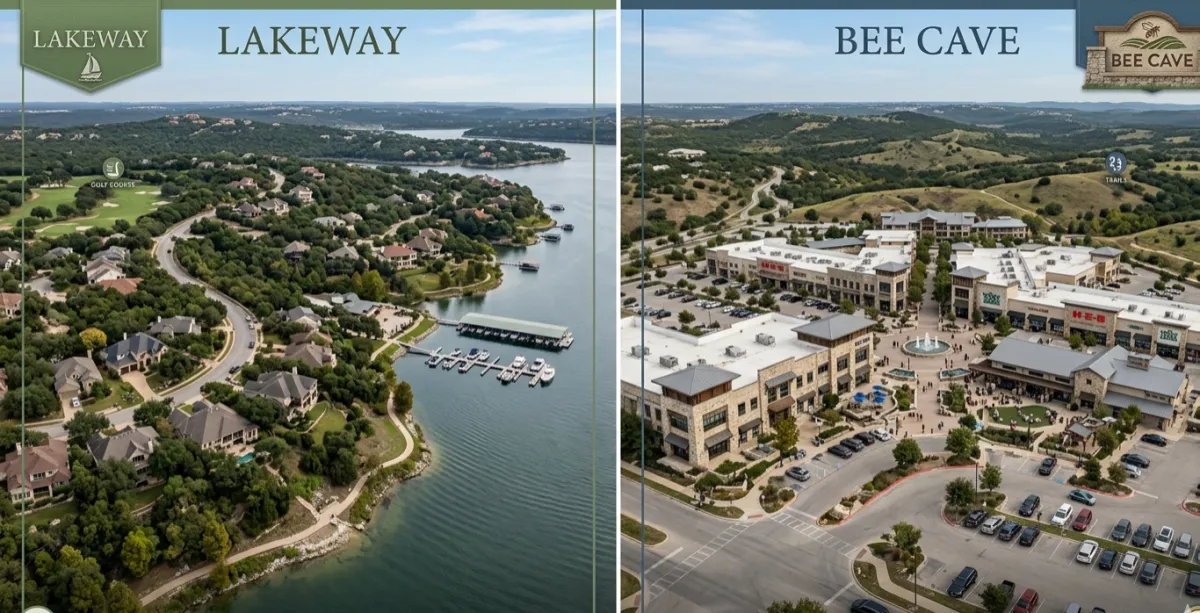
Bee Cave vs Lakeway Property Taxes 2026: The Hidden Cost Gap Nobody Talks About
Bee Cave vs Lakeway Property Taxes 2026: The Hidden Cost Gap Nobody Talks About
When buyers compare Bee Cave and Lakeway, the conversation almost always goes to schools, commute, and lifestyle. That is the right conversation. But there is a financial conversation that almost never happens until after closing, and it is costing some homeowners north of $5,000 a year more than they anticipated.
Property taxes, MUD district fees, and utility structures in these two communities are meaningfully different. For a buyer choosing between an $800,000 home in Bee Cave and an $800,000 home in Lakeway, the difference in annual carrying costs can be enough to change the entire math on the purchase.
This is the breakdown your agent should have given you.
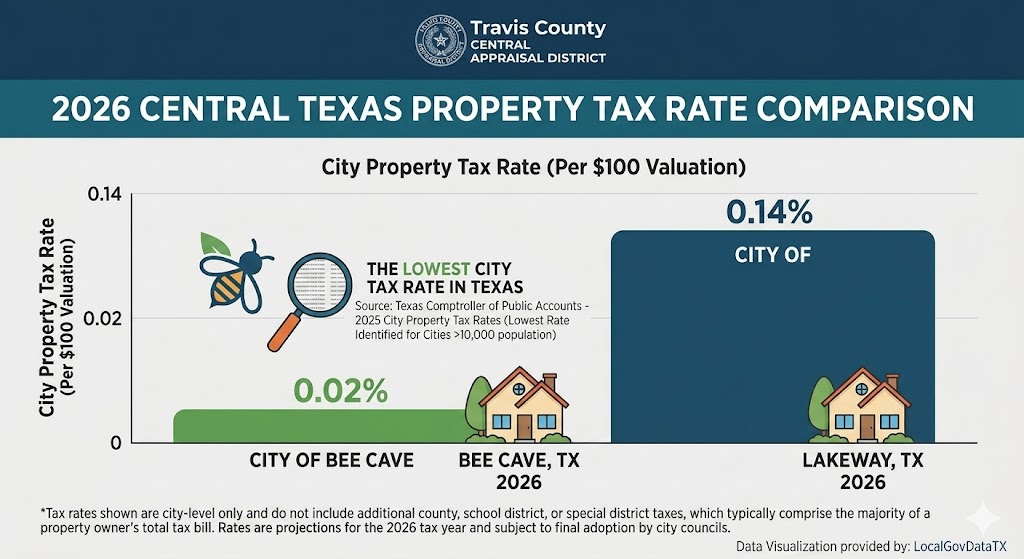
The headline number almost nobody knows about Bee Cave: the City of Bee Cave has maintained a property tax rate of $0.02 per $100 of assessed value, a rate it has held for the past 20 consecutive budget cycles, making it one of the lowest municipal tax rates in the entire state of Texas. That is two cents per hundred dollars. On an $800,000 home, the city portion of your tax bill is $160 per year.
Lakeway is a different story. The City of Lakeway adopted a tax rate of $0.1598 for fiscal year 2024-25, a 10.97% increase year over year. On that same $800,000 home, the city portion alone is approximately $1,278 per year over $1,100 more than Bee Cave just from the city rate.
Breaking Down the Full Tax Bill
City rate is just one layer. The full property tax bill in both communities stacks multiple taxing entities. Here is what buyers actually pay across all layers in 2026.
Bee Cave (Lake Travis ISD)
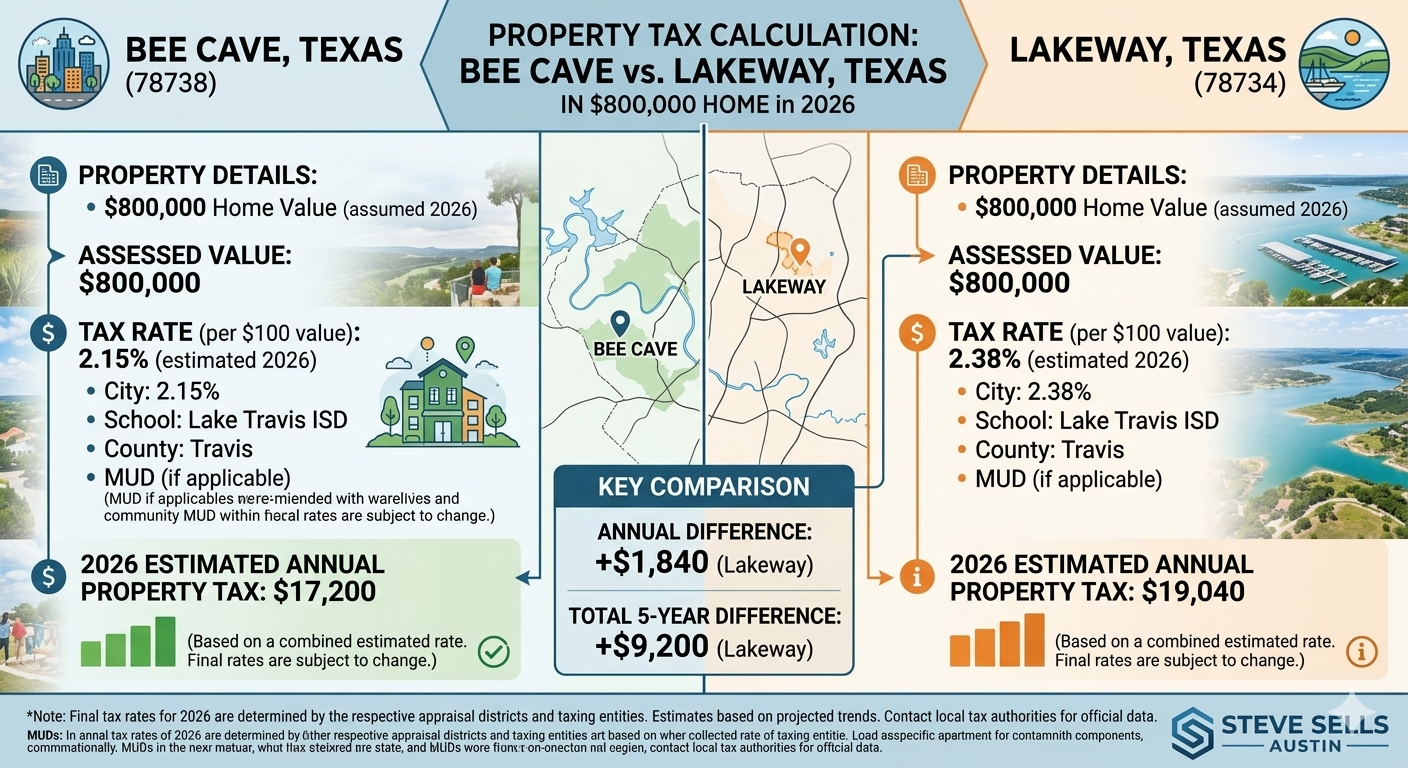
Lake Travis ISD adopted a total tax rate of $1.0397 per $100 of assessed value for fiscal year 2025-26, which is the lowest tax rate in LTISD history. Add Bee Cave's city rate of $0.02 and Travis County's rate of approximately $0.3713, and the combined rate in most Bee Cave neighborhoods lands around 1.75% to 1.95% depending on the specific lot and whether a Municipal Utility District applies. Zillow
On an $800,000 home in Bee Cave, a buyer should budget approximately $14,000 to $15,600 per year in property taxes.
Lakeway (Lake Travis ISD)
Lakeway carries the same Lake Travis ISD rate of $1.0397, the same Travis County rate, but a meaningfully higher city rate of $0.1698. The combined effective rate in Lakeway runs approximately 1.85% to 2.2%, with the higher end driven by MUD districts in specific sub-communities.
The MUD factor is where Lakeway buyers get surprised. Materials for Rough Hollow products have shown totals around the low to mid 2% range including a MUD component. In high-amenity master-planned communities within Lakeway like Rough Hollow, the MUD district adds an additional layer that can push total effective rates well above the city average.
On an $800,000 home in Lakeway, plan for $14,800 to $17,600 per year depending on the sub-community.
The annual gap on an $800,000 home: $800 to $2,000+ in favor of Bee Cave. On a $1.2 million home, that gap can exceed $3,000 to $4,500 per year.
The Westlake Hills Variable
Buyers who are comparing the western suburbs more broadly often ask about Westlake Hills too. Eanes ISD adopted a tax rate of $0.8322 for fiscal year 2025-26, a slightly lower rate than last year reflecting continued state-mandated rate compression. Unlock MLS
West Lake Hills adopted an ad valorem tax rate of $0.176783 per $100 of assessed valuation for FY 2025-26, with the tax on the average residence totaling $3,828.72 based on an average taxable residence of $2.17 million. Robertsonregroup
The Eanes ISD rate is lower than Lake Travis ISD, and Westlake Hills' city rate is comparable to Lakeway. But the home values are dramatically higher, with medians approaching $3.6 million. The lower rate on a much higher value produces a tax bill that dwarfs either Bee Cave or Lakeway in absolute dollars, even though the effective rate is similar.
Who Should Be Paying Attention to This
This analysis matters most for three types of buyers. First, buyers who are comparing homes at similar price points in both communities and want to understand the true annual carrying cost difference. Second, buyers who are stretching their budget and need to account for every dollar of monthly expense. Third, out-of-state buyers relocating from states with property tax caps, particularly California under Proposition 13, who are frequently surprised by the Texas property tax system regardless of which community they choose.
If you are relocating to Austin from California, budgeting for Texas property taxes properly is one of the most important financial adjustments you will make. The tax savings from no state income tax are real, but they are partially offset by property taxes that reset to current market value with no cap on annual increases.
The Utility and HOA Layer
Property taxes are the largest variable, but they are not the only one. HOA fees in Lakeway's master-planned communities vary dramatically.
Standard neighborhoods might run around $40 to $75 per month, while high-amenity master plans with pools, fitness, parks, and yacht-club access can range from about $90 up to $600 or more per month depending on the home and membership requirements.
In Bee Cave, HOA fees exist in most communities but tend to run in the $60 to $200 per month range for established neighborhoods, with the higher-end gated communities reaching $300 or more.
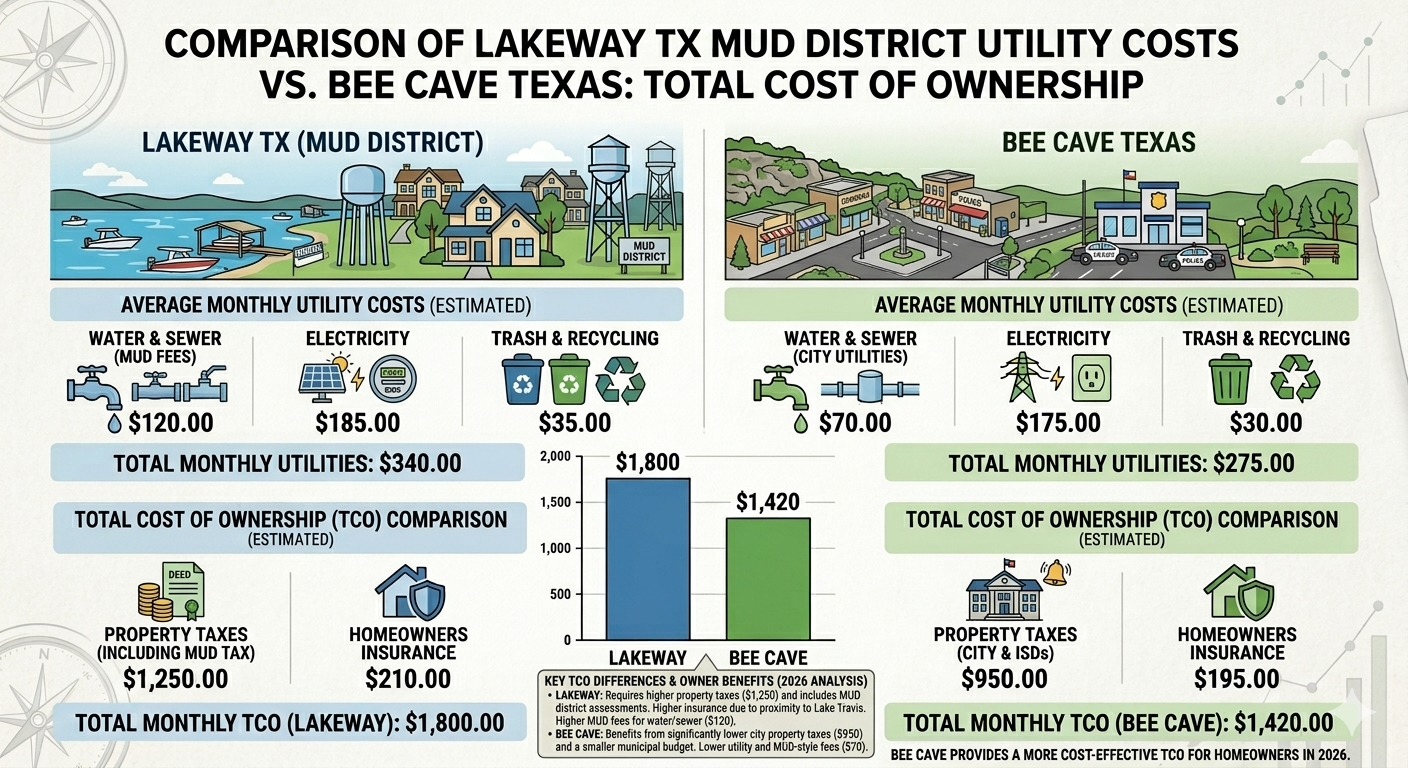
Utility costs, including water, electricity, and trash, are broadly comparable between the two communities, both being served by similar providers in the Lake Travis service area. The bigger utility variable in both markets is the size and age of the home rather than the community itself.
The Real Number: What the $5,000 Gap Looks Like
Here is the full annual cost comparison at the $1 million price point, which sits between the Bee Cave and Lakeway medians and gives a clean comparison.
A $1 million home in Bee Cave with an effective rate of 1.8% generates approximately $18,000 in annual property taxes. Add a moderate HOA of $150 per month, and total annual carrying costs excluding mortgage come to roughly $19,800.
A $1 million home in Lakeway in a high-amenity MUD community with an effective rate of 2.2% generates approximately $22,000 in annual property taxes. Add a full-amenity HOA of $400 per month, and annual carrying costs reach roughly $26,800.
That is a $7,000 annual difference between otherwise similar homes at the same price point. Over a 10-year hold, that is $70,000 in cumulative carrying cost advantage for the Bee Cave buyer.
None of this means Lakeway is the wrong choice. The Lake Travis waterfront access, the marina communities, and the established neighborhood character of Lakeway offer genuine value that many buyers find worth the premium. But you should know exactly what you are paying for before you commit.
For buyers who have not yet decided, understanding the full cost-of-ownership picture is exactly the kind of analysis that should happen before you fall in love with a specific property. The lifestyle comparison between these two communities is covered in depth in our Bee Cave vs Lakeway neighborhood guide. The school district comparison is built into our guide to living in Bee Cave and our guide to living in Lakeway. And for the broader picture of what Austin's current market means for buyers, the 2026 Austin market overview has everything you need.
The cost-of-ownership question is one I help buyers work through every week. Book a free 15-minute call and we will run the actual numbers for the specific homes and sub-communities you are considering, so you can make a fully informed decision before you ever write an offer.
Frequently Asked Questions
What is the property tax rate in Bee Cave TX in 2026? Bee Cave's city property tax rate is $0.02 per $100 of assessed value, the lowest in the region. The total effective tax rate including Lake Travis ISD, Travis County, and other entities runs approximately 1.75% to 1.95% depending on the specific property.
What is the property tax rate in Lakeway TX in 2026? The City of Lakeway's rate is approximately $0.1698 per $100. Total effective rates including Lake Travis ISD and Travis County run approximately 1.85% to 2.2%, with properties in MUD districts like Rough Hollow reaching the higher end of that range.
Is Bee Cave or Lakeway cheaper for property taxes? Bee Cave consistently carries lower effective property tax rates due to its uniquely low city rate of $0.02. On comparable homes at the same price point, Bee Cave buyers typically pay $800 to $3,000 less per year in property taxes depending on the specific sub-community.
What is a MUD district and how does it affect my taxes in Lakeway? A Municipal Utility District is a special taxing district that finances infrastructure in newer developments. In Lakeway sub-communities like Rough Hollow, a MUD adds an additional tax layer on top of city, school, and county rates, which can push total effective rates meaningfully higher than the Lakeway city average.
What is the property tax rate in Westlake Hills TX in 2026? Westlake Hills adopted a city rate of $0.176783 for FY 2025-26. Combined with Eanes ISD's rate of $0.8322 and Travis County, the total effective rate runs approximately 1.38% to 1.55%. However, with median home values approaching $3.6 million, absolute tax bills in Westlake Hills are significantly higher than in either Bee Cave or Lakeway.